
Saturday, May 20, 2023
Our Big Chill
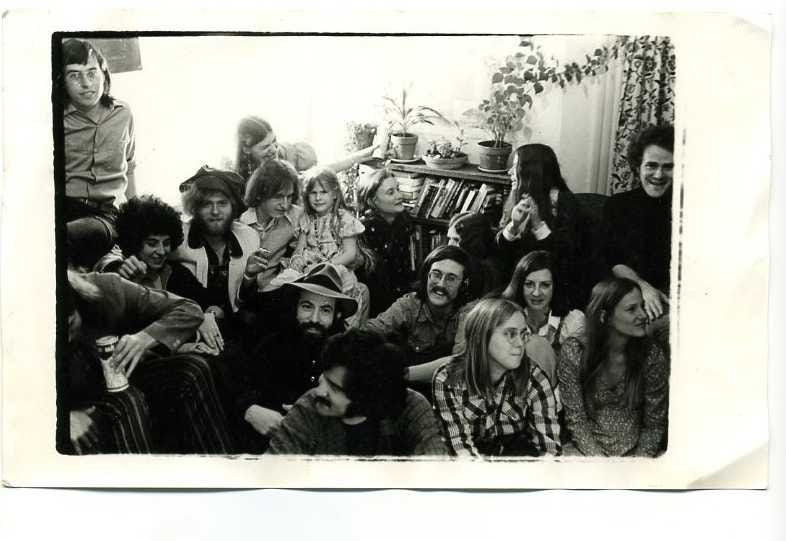
A few Ann Arbor expats gathered in my apartment in the Fillmore district of San Francisco in the early '70s.
I was born in Detroit two years after the end of World War II. My family moved into one of the city’s expanding suburbs, Royal Oak, amidst a cluster of other families that consisted of returning soldiers, wives and boys and girls named David, Susan, Bill, Bob, Jim, Mark, Bonnie, Nancy, Kathy, Fred, Peter, Carole, Paul, Diane, Mary, John, and so on and so forth.
We were the leading edge of the Baby Boom generation -- a cohort so large that we broke every institution we encountered. When we got to school, there were never enough classrooms, chairs, desks, books, or other resources. Teachers suddenly had to handle many more students at once than had previously been the case.
When we reached our teens, there simply was not enough overt passion in the music that our parents and older siblings enjoyed. Thus, the mass market for rock and roll was born.
Meanwhile, the political economy of the nation newly victorious in the second war of wars dictated that America become an empire, as all conquerors since time immemorial have done.
As we grew up, America's capitalist empire -- imperialistic, arrogant, and consumed by fear of communism -- spread globally.
We were served books like "Our Friend the Atom," a distinctly propagandistic reader that was our government's attempt to convince us, years before we could vote, of the rightness of its policy to develop nuclear power plants while stockpiling WMD's to protect us from the Russians, Chinese, and other socialistic foreigners.
Much of the rest of my generation's story is written contemporaneously in music, in poetry, in film, and in our collective memory. Confronted with the worldview that our fate was to conquer the world, many of us rebelled, begging to differ.
We opposed the war in Vietnam. We marched in support of the civil rights movement. We launched the modern women's liberation movement and the gay liberation movement. We smoked dope and dropped acid and danced in the streets.
We were environmentalists and self-help advocates, idealists and cynics, hippies and radicals. For our guides, we had Dylan and the Beatles, the Stones, and so many more. One of our earliest heroes, when we were still kids, was Elvis. The music always reflected us as the ragged edges of a churning chainsaw that sliced our way through society trying to establish a new way of being.
Did we succeed in doing that? The culture wars persist to this day, so I guess not. But some of us are still trying.
(I published an early version of this essay in 2006.)
LINKS:
US will help train Ukraine fighters on F-16 jets, Biden tells G7 (Financial Times)
G7 summit: Zelensky accuses some Arab leaders of 'blind eye' to war ahead of Japan trip (BBC)
“China’s Navy has expanded dramatically over the last two decades”—closing the military gap (Economist)
World watches in disbelief and horror as U.S. nears possible default (WP)
An LGTBQ+ pride event usually held in Tampa, Florida, has been canceled after Gov. Ron DeSantis (R) signed a bevy of anti-LGBTQ+ bills into law this week. “In the end, we didn’t want to take any chances," the city's Pride president said. [HuffPost]
Anti-Trump Republicans increasingly desperate to shake up race (The Hill)
Fearing leaks, Apple restricts its employees from using ChatGPT and AI tools (Ars Technica)
OpenAI launches a free ChatGPT app for iOS (CNN)
ChatGPT Is Already Obsolete — The next generation of AI is leaving behind the viral chatbot. (Atlantic)
Striking Hollywood scribes ponder AI in the writer's room (NPR)
Meta and Google news adds fuel to the open-source AI fire (Venture Beat)
I Finally Bought a ChatGPT Plus Subscription—and It’s Worth It (Wired)
With ChatGPT, Honeycomb Users Simply Say What They’re Looking for (New Stack)
The Birth of the Personal Computer (New Yorker)
Google Is Spared a Search-Engine Switch by a Major Partner (WSJ)
Uber will lease out entire office building in San Francisco (SFGate)
Georgia prosecutor clears decks for possible Trump charges (The Hill)
Human-evolution story rewritten by fresh data and more computing power (Nature)
The world’s largest lakes are shrinking dramatically, and scientists say they have figured out why (CNN)
New York City is sinking due to weight of its skyscrapers, new research finds (Guardian)
Floridians Demand to Know Where Disney Is Going so They Can Come With (New Yorker)
Friday, May 19, 2023
The Treasure
During my first divorce, as I moved my stuff in my car to a friend’s house across town, everything got jumbled together in boxes, so it was hard to sort out. A month later, I moved again, this time to another house where I would spend most of the coming year.
Slowly, as I settled in, I unpacked the boxes and sorted through old letters and books, some reaching back to my childhood. My oldest son, then about eight, had just become a big baseball fan, rooting for the Giants, playing little league, and collecting baseball cards. I told him about my own card collection back in the Fifties, when I was around his age.
He came over to spend the night one Saturday and I dug through my boxes to see whether any baseball-related stuff had survived the many moves I'd made since childhood. Out tumbled an old scrapbook, circa 1958, with prime baseball cards of legendary stars including Willy Mays, Jackie Robinson, Mickey Mantle and Ted Williams, among others, glued inside.
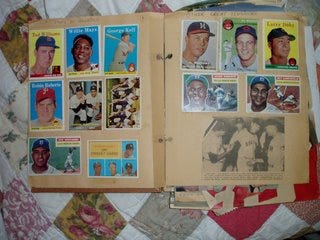
We both gasped. Collectively, these old cards might be worth a small fortune! We were both looking for positive signs that our future might turn out to be brighter than it appeared to be at that time, so this was potentially good news.
This was long before the likes of eBay, so I checked directly with collectors, who explained the cards might be valuable assuming they could be removed from the scrapbook without damaging them.
Alas, upon further investigation it turned out that removing them would destroy them. So we just left them in the place where had I pasted them all those decades ago.
We still loved having them and he would show them to friends when they came over. Eventually, I realized the only real value they had was they helped us create a memory of one moment together. And over time, I’ve come to treasure that memory much more than money anyway.
LINKS:
McCarthy says House could vote on debt ceiling deal as soon as next week (CNBC)
Biden declares ‘America will not default,’ says he’s confident of budget deal with GOP lawmakers (AP)
Supreme Court shields Twitter from liability for terror-related content and leaves Section 230 untouched (CNN)
Trust in Supreme Court fell to lowest point in 50 years after abortion decision, poll shows (AP)
Leak suspect shared classified secrets with foreign nationals, prosecutors say (WP)
Adults in Florida can now be criminally charged if they don’t use the bathroom that matches the sex they were assigned at birth after Gov. Ron DeSantis (R) signed one of the most draconian bathrooms bills in the U.S. Advocates have raised concern over the bill's vague text and how the law would be enforced. [HuffPost]
Texas Legislature Bans Transgender Medical Care for Children (NYT)
U.S. cities are growing again after losing population during the pandemic. Most of the 37 cities with more than 500,000 people saw their populations fall in the first year of the coronavirus pandemic. All but six are rebounding, according to new census data. (WP)
Hiding Behind the AI Apocalypse (Atlantic)
Meta built a code-generating AI model similar to Copilot (TechCrunch)
In Battle Over A.I., Meta Decides to Give Away Its Crown Jewels (NYT)
6 major risks of using ChatGPT, according to a new study (ZDNet)
Here’s How AI Will Come for Your Job (Atlantic)
Where AI evolves from here (Axios)
A professor falsely accused his class of using ChatGPT. Their diplomas are in jeopardy. (WP)
TikTok Feeds Teens a Diet of Darkness (WSJ)
The Daring Robot Surgery That Saved a Man’s Life (Wired)
Why former Trump White House lawyer thinks Trump will go to jail (CNN)
The wind-turbine industry should be booming. Why isn’t it? (Economist)
Russia fires 30 cruise missiles at Ukrainian targets; Ukraine says 29 were shot down (AP)
Russia launches ninth wave of missile attacks on Kyiv this month (BBC)
The Latest Rift Among Ukraine’s Allies Is Whether to Send F-16s (NYT)
Iran warns Afghanistan’s Taliban rulers not to violate its water rights, over Helmand River (AP)
Colombia plane crash: Children reportedly survived 17 days in jungle (BBC)
Why birds and their songs are good for our mental health (WP)
Octopuses may have nightmares about predators attacking them (New Scientist)
VIDEO: Scientists Create Detailed Digital Replica of the Titanic Shipwreck
(Atlantic Productions/magellan)
Napkinless Man With Grease-Covered Fingers Realizes He Trapped In A Prison Of His Own Creation (The Onion)
Thursday, May 18, 2023
Limits of the First Order
Every profession has its sleazy fringe. Lawyers have ambulance-chasing hucksters, cops have racists who beat up people, politicians…don’t get me started.
Journalists, unfortunately, are no exception. Over at the extreme edge are the paparazzi, who hide behind press freedoms to torment Royals and other celebrities.
The photographers that allegedly hid their license plates in Tuesday night’s incident involving Harry and Meghan in New York should be stripped of their press credentials, if the initial reports are accurate, and prosecuted for traffic violations as a bare minimum.
The rest of us are sick of them polluting our work environment with their intrusions on personal privacy. They do not represent us and no honest journalist I know would ever treat anyone the way they do.
For that matter, nor do we want anything to do with the conspiracy propagandists on right-wing networks and social media. Congress has every right to narrow Section 230 of the CDA, and the Big Tech companies have very right to limit the voices of those who circulate the conspiracy theories that undermine democracy.
And yes, Fox had every right (and obligation IMHO) to get rid of Tucker Carlson.
I am a “hawk” on these issues; I believe in strengthened government regulation to limit press freedom where necessary and appropriate. A First Amendment absolutist I am not.
LINKS:
Harry, Meghan in 'near catastrophic' New York paparazzi car chase, spokesperson says (Reuters)
Prince Harry and Meghan made getaway in NYC taxi after being trailed by paparazzi (AP)
Supreme Court denies request to block Illinois ban on semi-automatic rifles (CBS)
Biden says he is ‘confident’ on reaching debt ceiling deal with Republicans (NBC)
Biden pushes back at tougher work requirements for welfare pushed by Republicans in debt-ceiling talks (USA Today)
Missouri ends rule limiting transgender care for minors, some adults (The Hill)
Key states are nearing a deal to protect the Colorado River. California, Arizona and Nevada would voluntarily conserve a major portion of their river water in exchange for over $1 billion in federal funds. (WP)
As Ukrainian Attack Looms, Putin Faces Setbacks and Disunity in Russian Forces (NYT)
A US-made Patriot missile defense system being used by Ukraine likely suffered some damage from a Russian strike, two US officials said, adding that it did not appear to have been destroyed. (Reuters)
ChatGPT Scams Are Infiltrating the App Store and Google Play (Wired)
AI leaders: Please regulate us (Axios)
Texas A&M Prof Flunks All His Students After ChatGPT Falsely Claims It Wrote Their Papers (Rolling Stone)
How AI Knows Things No One Told It (Scientific American)
How do you solve a problem like out-of-control AI? (MIT Tech Review)
Will ChatGPT Replace Google? Here's What We Know (Motley Fool)
Inside the AI culture war (Politico)
Before AI Takes Over, Make Plans to Give Everyone Money — The U.S. needs policies now to support workers made redundant by artificial intelligence. (Atlantic)
'Age of Danger' explores potential risks because AI doesn't understand rules of war (NPR)
StableStudio is Stability AI’s latest commitment to open-source AI (Verge)
An AI glossary: the words and terms to know about the booming industry (NBC)
The Story Behind the Stabbing of a San Francisco Tech Exec (WSJ)
Man Plagued By Intrusive Thoughts Of Wanting To Help Others (The Onion)
Wednesday, May 17, 2023


Why Journalists Speak Out
Over many decades of teaching classes, appearing on panels, speaking at ethics seminars, and doing or supervising hundreds of reporting projects, one of the most frequent questions I faced was how journalists were supposed to possibly stay objective when doing this work.
The short answer to that is that we can’t. And we don’t.
In the course of producing stories, we learn so much about the various people and institutions we cover, it is simply not possible to avoid drawing conclusions and forming opinions about them.
So of course we do. And the more informed we become, the stronger our opinions tend to become. It’s only human.
The question is what do we then do with our opinions? Can we keep covering the same stories, pretending to be objective?
Traditionally, in newspapers, there was a strict line between the reporting we did in news coverage and the opinions expressed on the editorial page. Beat reporters rarely ventured over to the opinion side, which was considered unseemly. But there was more than a bit of irony in that as we were often the best-informed people employed by the paper on the subjects on the editorial page.
One attempt to bridge this gap was to have the beat writers produce analysis pieces, which bridged the gap between reporting and opinion and were traditional journalism’s answer to the objectivity problem.
The distinction between “analysis” and “opinion” was largely fictional but it was a useful fiction that newspapers employed successfully for many years.
Another aspect of the objectivity problem was that the ownership of the newspaper often held different opinions and loyalties on the major topics of coverage from the reporters and editors who provided that coverage on a day-in, day-out basis.
This led to a great deal of tension on occasion between the news staff and those in charge of the editorial pages. Trust me, anyone who ever visited the nearest bar to a big-city newspaper office knows exactly what I am talking about.
When baby boomers — the largest generation ever to hit American workplaces including media — came along, we brought a new level of tension to this traditional dichotomy between news and opinion — and the myth of objectivity.
For one thing, we were better educated than the older generation and way too many of us had been shaped by the civil rights and anti-war movements to remain neutral on the great issues of the day. We weren’t neutral at all on questions like racism or colonial wars — we knew right from wrong.
Furthermore, we didn’t like what we found of the culture inside most newsrooms, which was all too often misogynistic, racist, homophobic and more like an arm of the local police union than a force for truth.
At the same time, we met heroes — established reporters and editors who resisted all those entrenched prejudices and practices that simply acted to reinforce powerful interests. These guys challenged those very interests on more than one occasion.
We also discovered that there were plenty of enlightened owners and executives in media who would support the type of crusading journalism we aspired to, so we worked for them whenever possible and joined the great muckraking traditions that long have served as a counterweight to mainstream, by-the-books news mongering in America.
When it came to remaining objective, we agreed that it was absolutely necessary to stay open-minded when we were gathering the facts about any situation. We needed to be open to adjusting our analysis as those facts came to light, and it was vital that we remained our own worst devil’s advocate to counter the biases and prejudices we inevitably brought to the story.
But you can’t discover the truth as you wish it to be, you have to accept the truth as you discover it to be. Equally importantly, you can’t bend the facts to fulfill the wishes or desires of your bosses or your audience — the chips must fall where they may.
But once all of that was said, once you’d been as fair as you could possibly be during the process of gathering facts, it became completely appropriate and indeed obligatory for any journalist of conscience to speak out when asked about the meaning of what we had found.
That’s how many of us became what some considered advocates or activists as well as journalists during our careers. We were often called “alternative journalists” or “new journalists” or “gonzo journalists.” Take your pick. And of course the traditionalists denounced us, for good reason. But once our reporting was complete, we made a point of speaking out.
That practice remains controversial to this day. But as my esteemed former Stanford colleague, Prof. Ted Glasser, once observed (and I paraphrase), “In the end, being a good citizen has to trump being a good journalist.”
Amen.
Note: I’ve published this essay previously a number of times, most recently in January.
LINKS:
US debt ceiling talks turn to work requirements for benefits programs (Reuters)
North Carolina’s GOP-led General Assembly overrides Democratic governor’s 12-week abortion ban veto (CNN)
Russia launches air raid attack against Kyiv (CBS)
Ukraine says it shot down advanced weapons fired from Russia (Today)
Microsoft Says New A.I. Shows Signs of Human Reasoning (NYT)
ChatGPT's clever way of balancing 9 eggs with other objects convinced some Microsoft researchers that AI is becoming more like humans (Business Insider)
Mr. ChatGPT goes to Washington: OpenAI CEO Sam Altman testifies before Congress on AI risks. (CNN)
US Senator Uses ChatGPT for Opening Remarks at a Hearing on AI (Bloomberg)
Digital data guardrails are the first step in regulating AI (The Hill)
Can We Stop Runaway A.I.? (New Yorker)
Google Bard gets another update that makes it better for research (TechRadar)
Open-Source AI Is Gaining on Google and ChatGPT (The Information)
ChatGPT is not ‘artificial intelligence.’ It’s theft. (Jesuit Review)
Couple uses artificial intelligence to redesign backyard: ‘AI is truly gonna take over so many jobs’ (Yahoo)
The Return to the Office Has Stalled (WSJ)
A lot of offices are still empty — and it's becoming a major risk for the economy (NPR)
A lonely nation: Has the notion of the 'American way' promoted isolation across history? (AP)
Move over, U.S. dollar. China wants to make the yuan the global currency. (WP)
Oceans have been absorbing the world’s extra heat. But there’s a huge payback (Guardian)
Bill Gates is full of regret about missed vacations and broken relationships in commencement speech: ‘You are not a slacker if you cut yourself some slack’ (Fortune)
George Santos Pleads Nonexistent (New Yorker)
Subscribe to:
Posts (Atom)