Tuesday, January 14, 2025

Whose Life Exactly?

Since I’ve worked for almost 60 years in the mixed worlds of journalism, Hollywood, academia, non-profit and private sectors, legacy and digital media, I often get questions about what happened during my long strange career.

It is rare that a week goes by that somebody doesn’t want to discuss something about the way it was in the 60s or 70s. I always try to comply with their requests, because I was a reporter for a long time and I know it’s frustrating when people resist such calls about what they remember.

Usually I’m willing to discuss pretty much anything except the identities of certain confidential sources or relationships that I pledged not to disclose. So that leaves a pretty wide latitude for conversation. 

Probably the most sought-after information is about my years at Rolling Stone and specifically the Patty Hearst stories.

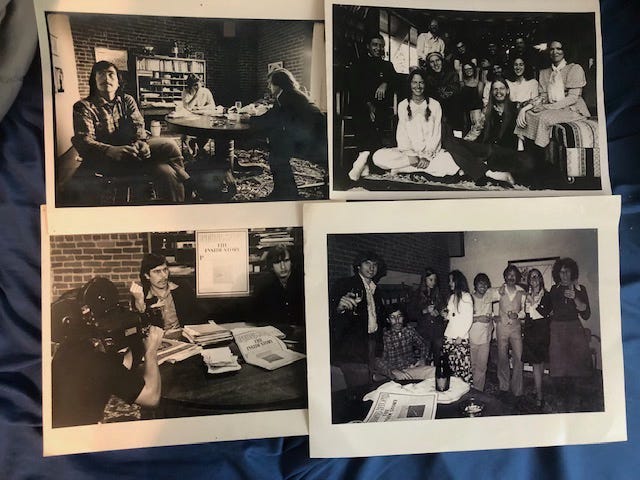
Fifty years ago, Howard Kohn and I had three cover stories on the newspaper heiress’s kidnapping and apparent conversion to the cause of her kidnappers, the domestic terror organization calling itself the SLA. Publisher Jann Wenner labelled it the “scoop of the decade.”

Even mundane details of our own lives at that time seem to be of some interest and one Hollywood producer recently asked me, “Do you ever think about how amazing it is that you did all of that? That you lived through it?”

I answered, “Sometimes it feels like it was in fact someone else, not me.”

After we hung up, I stayed with that thought about it feeling like somebody’s else’s life, not mine. I suspect a lot of people feel that way about the distant past and the things that happened back then — things that may sound strangely exotic now.

Given that we grow and change throughout our lives it is kinda true, too, that many of us were pretty much someone else when we were younger. And speaking only for myself, I have no regrets about that.

But the other thing about the perspective of distance on those long-ago events — they shrink into a small piece of a much larger mosaic of people and places and what matters over, under and through time. 

As he often does, Dylan get this just right, albeit in another context:

The slow one now
Will later be fast
As the present now
Will later be past
The order is rapidly fadin'
And the first one now
Will later be last

***

Note: Howard Kohn and I will be celebrating the 50th anniversary of the Patty Hearst stories in Rolling Stone this summer with a reunion in San Francisco.

HEADLINES:

  • Judge Cannon paves the way for potential release of Part 1 of special counsel's report (NPR)

  • Trump appears desperate to keep Jack Smith’s findings under wraps (MSNBC)

  • A Wider War Has Already Started in Europe (Atlantic)

  • Russia Is Stepping Up Its Covert War Beyond Ukraine (Foreign Policy)

  • Weather service issues its most severe fire warning for parts of L.A. area as winds pick up (LAT)

  • Cal Fire air crews brace for more Santa Ana winds (NBC)

  • After Attacking L.A. Wildfire Response, Elon Musk Sends His Products to Help (NYT)

  • Who will rebuild Los Angeles? Immigrants. (WP)

  • US officials say Gaza ceasefire deal is in sight, the first sign of serious optimism in months (CNN)

  • Some Israeli soldiers refuse to keep fighting in Gaza (AP)

  • House GOP crafts bill to let Trump purchase Greenland (Axios)

  • Trump ally Steve Bannon vowed to "have Elon Musk run out of here by Inauguration Day," calling the tech billionaire a "truly evil guy." [HuffPost]

  • Hegseth could lead troops who'd face getting fired for actions he's done in the past (AP)

  • The Pressure Campaign to Get Pete Hegseth Confirmed as Defense Secretary (New Yorker)

  • Treasuries Selloff Ripples Through World Markets After Jobs Data (Bloomberg)

  • Cuts to Medicaid that could cause millions of Americans to lose health insurance are reportedly on a "menu" of possibilities for spending cuts circulating among House Republicans. [HuffPost]

  • Indian festival is expected to draw the world's largest gathering of humanity. (Reuters)

  • Nvidia CEO Jensen Huang: "AI Agents Likely to Be a Multitrillion-Dollar Opportunity" (Motley Fool)

  • Biden’s sweeping new AI export controls cover most of the world (WP)

  • Adobe’s new AI tool can edit 10,000 images in one click (Verge)

  • Robotics adds 'significant boost' to labor force: RoboForce CEO (Yahoo)

  • AGI Is Coming In 2025. Schools Urgently Need A Strategy (Forbes)

  • Distressing Survey Finds Most U.S. Citizens Unable To Name All 340 Million Americans (The Onion)

TODAY’S ARCHIVAL VIDEO:

The Beach Boys- Shindig! (All Performances) When to be cool was oh so innocent, in black and white. 

Monday, January 13, 2025

The Good Journalist

Over decades of teaching, appearing on panels and supervising reporting projects, one of the most frequent questions I have faced is how journalists remain objective while reporting our stories.

The answer is complicated. You might say that we don’t, and while you wouldn’t be entirely wrong, that is hardly the end of the story.

In the course of producing stories, we learn so much about the various people and institutions we cover that it isn’t humanly possible to avoid forming opinions about them.

So how do we keep our coverage fair despite this? One way to think about it is what you are asked to do when serving on a jury. If you have any bias toward the person on trial, you’re asked to put that aside and only take the facts as they are proved into account when making your judgment. 

Most journalists would make great jurors because they act like them on every story that comes across their desks.

In fully staffed newsrooms, we’ve traditionally also had systems in place to counteract any prejudicial statements that make their way into the early drafts of articles. Our colleagues, editors and fact checkers — and in big stores, our lawyers — act collectively as devil’s advocates to test and retest our assumptions and conclusions.

Unfortunately, much of what I’m describing is from the newsrooms of the past, which may no longer exist in many of today’s media organizations after waves of layoffs, buyouts and corporate takeovers.

But with or without those layers of support, the burden remains on every journalist to produce fair and balanced stories and above all else to get it right.

Because in the end, the truth is our best defense.

***

Traditionally, in newspapers, there was a strict line between the reporting we did in news coverage and the opinions expressed on the editorial page. 

One attempt to bridge this gap was to have the beat writers produce analysis pieces, which bridged the gap between reporting and opinion and were traditional journalism’s answer to the objectivity problem.

Though the distinction between “analysis” and “opinion” was largely fictional, it was a useful fiction that newspapers employed successfully for many years.

Meanwhile, the ownership of the newspaper often held different opinions and loyalties on the major topics of coverage from the reporters and editors who provided that coverage on a day-in, day-out basis.

This led to a great deal of tension on occasion between the news staff and those in charge of the editorial pages. Anyone who ever visited the nearest bar to a big-city newspaper office knows exactly what I’m talking about.

(Recent examples include the endorsement controversies at the Washington Post and L.A. Times prior to last November’s election.)

When baby boomers — the largest generation ever to hit American workplaces — came onto the scene, we brought a new level of tension to the line between news and opinion — and the myth of objectivity.

For one thing, we were better educated than the older generation and many of us had been deeply affected by the civil rights and anti-war movements. We weren’t neutral at all on the biggest questions like racism or imperialism — we knew where we stood.

Furthermore, we didn’t like what we found of the culture inside most newsrooms, which was all too often misogynistic, racist, homophobic and more like an arm of the local police department than a force for truth.

At the same time, we found established reporters and editors who resisted all those entrenched prejudices and practices and challenged them at key moments. These were our heroes.

We also discovered that there were a few enlightened owners and executives in media who would support the type of crusading journalism we aspired to, so we worked for them whenever possible and joined in the great muckraking traditions that long have served as a counterweight to mainstream, by-the-books news mongering in America.

When it came to remaining objective, we knew we needed to stay open to following the facts to wherever they led, and that it was vital to act as our own devil’s advocate to counter the biases and prejudices we inevitably brought to the story.

In the end, to be a journalist you have to be able to present the truth as you discover it to be, not as you might wish it to be.

Once all of that was said, once you’d been as fair as you could possibly be during the process of gathering facts, it became completely appropriate on occasion to speak out when asked about the meaning of what we had found.

That’s how some of us came to be called “alternative journalists” or “new journalists” or “gonzo journalists.” Take your pick. Once our reporting was complete, we spoke out. 

That practice remains controversial to this day. But as my esteemed former Stanford colleague, Prof. Ted Glasser, once observed (and I paraphrase), “In the end, being a good citizen has to trump being a good journalist.”

Amen.

HEADLINES:

TODAY’S ARCHIVAL VIDEO:

Ronettes - "You Baby" (ultra clear video resolution) This classic black-and-white video captures the sexiest of the so-called “girl groups” of early rock n roll.

Sunday, January 12, 2025

The Story Man

“Art is disagreement.” — Bob Dylan

There is a contradiction built into the work of any artist who achieves success. The artist wishes, needs to keep changing, while those celebrating the art really just want to celebrate the known. 

Such is the reality of Bob Dylan and his never-ending experiment. He hasn’t stopped changing or following his instincts, but his audiences have often had trouble keeping up.

Of course, in the commercial realm, he has one of those problems that is good to have — old songs that keep generating new revenue. The fans may want him to play them over and over, long after he has moved on. 

I admire Dylan the writer, the storyteller who can spin a good tale within the limited parameters of a song. Well, not so limited in some cases — among my many favorites are his impossibly long, soulful ballads that seem like they could go on and on forever.

Just like the man.

But I’m in awe of him as an artist and his unending commitment to his art. Not to mention his sheer life force — he has kept writing and singing into his eighties. And he never stops breaking new ground because that is what he’s always really been all about.

Recommended Reading: “Art is Disagreement — A Complete Unknown and the myths of Bob Dylan” (The Nation)

HEADLINES:

TODAY’S SONG:

Bob Dylan - I've Made Up My Mind to Give Myself to You (Official Audio)

I'm sitting on my terrace, lost in the stars
Listening to the sounds of the sad guitars
Been thinking it all over and I've thought it all through
I've made up my mind to give myself to you

I saw the first fall of snow
I saw the flowers come and go
I don't think that anyone ever has ever knew
I've made up my mind to give myself to you

I'm giving myself to you, I am
From Salt Lake City to Birmingham
From East L.A. to San Antone
I don't think I can bear to live my life alone

My eyes like a shooting star
It looks at nothing here or there, looks at nothing near of far
No one ever told me, it's just something I knew
I've made up my mind to give myself to you

If I had the wings of a snow-white dove
I'd preach the gospel, the gospel of love
A love so real, a love so true
I've made up my mind to give myself to you

Take me out traveling, you're a traveling man
Show me something I don't understand
I'm not what I was, things aren't what they were
I'll go far away from home with her

I've traveled a long road of despair
I've met no other traveler there
Lot of people gone, lot of people I knew
I've made up my mind to give myself to you

Well, my heart's like a river, a river that sings
Just takes me a while to realize things
I've seen the sunrise, I've seen the dawn
I'll lay down beside you when everyone's gone

I've traveled from the mountains to the sea
I hope that the gods go easy with me
I knew you'd say yes, I'm saying it too
I've made up my mind to give myself to you

Saturday, January 11, 2025

Big Man v. Big State


It may not be enough for incoming President Trump to lash out and take over some of our neighboring countries. He may be preparing for an internal conflict as well.

Scholars at the University of California, Berkeley, warn that Trump could be preparing to wage war against California, with its entrenched Democratic government and supposed progressive values.

According to the experts’ analysis, Trump may elect to escalate the federal-state conflict to unprecedented levels, using funding cuts, administrative pressure and political muscle to break the state’s will.

“After the election, (Gov. Gavin) Newsom made national headlines by calling a special legislative session to enact laws and financial allocations to “Trump-proof” the state. But as Newsom emerges as a national political opponent to the administration, and as he considers a 2028 run for the White House, Trump may have even more incentive to go to war.”

  • He could withhold emergency aid in the event of wildfires, earthquakes or floods. 

  • He could slash higher education funding for the state, or aggressively challenge the state’s influential climate and environmental standards. 

  • He could attempt to override the state’s protections for reproductive health care and undermine public health policies.

Of course, Trump loudly complain but then do none of these things, because California has by far the largest economy of any state — it accounts for 14% of the nation’s total economy— and any moves to destabilize it could have severe repercussions for the country overall.

So this is just one of the many scenarios that could await us under the new Trump presidency. Aides say he has prepared at least 100 executive orders to be issued on his first day in office.

HEADLINES:

  • Los Angeles has never seen this level of destruction: ‘Everything is burned down’ (LAT)

  • The Insurance Crisis That Will Follow the California Fires (New Yorker)

  • Trump may be planning a sharp, extended conflict with California, experts say (U-C, B)

  • Elon Musk's latest foray into politics: a live chat with Germany's far-right candidate (NPR)

  • President-elect Donald Trump is a convicted felon. Here are the rights he is set to lose (NBC)

  • Supreme Court seems likely to uphold law to sell or ban TikTok (WP)

  • Hiring Blew Past Expectations With 256,000 Jobs Added in December (WSJ)

  • Hot jobs surprise gives Fed breathing room (Axios)

  • Dow falls almost 700 points after blowout jobs report dashes hopes for more rate cuts (CNN)

  • Surging job market could prove costly for households and businesses as odds of quick rate cuts fade (AP)

  • Biden extends protected status for nearly 1 million immigrants (WP)

  • Do Russians Really Support the War in Ukraine? (New Yorker)

  • Earth records hottest year ever in 2024, breaching a key threshold (AP)

  • The Anti-Social Century (Atlantic)

  • US announces $25m reward for arrest of Venezuela's Maduro (BBC)

  • Timothée Chalamet returns to ‘SNL’ as host — and musical guest (AP)

  • Art is Disagreement — A Complete Unknown and the myths of Bob Dylan (The Nation)

  • This Artificial Intelligence (AI) Stock Could Be the Best Investment of the Decade (Motley Fool)

  • Biden Wanders Into Flames (The Onion)

TODAY’s QUOTE:

“Art is a disagreement,” BobDylan writes in his most recent book, The Philosophy of Modern Song. “Money is an agreement.”

Friday, January 10, 2025

Brighter Side

Top Story: 

Donald Trump 1st US President To Be Sentenced As Felon, But Avoids Jail, Penalty (NDTV)

***

One of the unforeseen consequences of digging up stories about what is wrong with the world over the course of a long career is the desire, every now and again, to celebrate what is right. Or at least what isn’t outright wrong.

Maybe it’s a natural corrective mechanism in our brains, some sort of a serotonin-induced urge to bring our overall story-telling function back into balance.

In any event, I was in just such a mood one evening in 2011 when I attended an anniversary party celebrating the tenth year of publication for San Francisco’s 7x7 magazine.

As the magazine’s founding editor, I was reuniting with my former colleagues that night and agreed on impulse to write a short piece recalling our launch back in September 2001. It was a bittersweet sort of story, because we had launched to great local fanfare just one week before the 9/11 terrorist attacks.

That the magazine subsequently survived the total loss of advertising income that resulted in the collapse of San Francisco’s tourist industry is remarkable, although one of the casualties of the extended economic downturn was my job.

I had to leave 7x7 after a year of working without pay and now, ten years later, they asked me if besides the retrospective, I’d also be willing to write blog posts for the magazine about some of the Web 2.0 startups then springing up all over town.

Why not?

Thus I wrote blog posts about Lyft, Uber, Airbnb, Nextdoor, TaskRabbit and dozens of others in the early days of their existence. I met their founders — scores of mostly young entrepreneurs armed with their founding myths and dreams of changing the way we live our lives. Almost all of them came to me for the interviews. We’d set a time and I’d walk around the corner, past the little markets where my kids bought candy, past the guys hanging out, past the restaurants where we’d sometimes order takeout, to one of the coffee houses nearby.

Most of the founders were idealistic, articulate young people and I found them easy to like. My job, as 7x7 and I envisioned it, was essentially to celebrate San Francisco as the new center of Silicon Valley. The original dot.com boom had been headquartered south on the peninsula, more in the vicinity of Palo Alto and San Jose than in its more famous neighbor to the north.

But Web 2.0 was different.

It may seem strange that an old investigative reporter would agree to write mostly positive profiles of these startups, and I suppose I have no good excuse, other than it felt good to finally be telling some happy stories for a change.

(In my defense, I also published some mini-investigations, such as the fact that none of the five largest social media companies yet had a woman on their boards of directors. That was zero women among 44 men.)

But I was genuinely optimistic about this new wave of change.

Not all of the companies would survive, of course, let alone thrive, but the strongest among them did. One can reasonably argue now about whether those that survived have made things better or not. But all of that was pretty much beside the point for me as a story-teller. I just remember enjoying the chance to write up my version of how somebody’s dream might come true.

Looking back, I just hope my old muckraker friends can forgive me.

After all, it must have been the serotonin.

HEADLINES:


Thursday, January 09, 2025

Big Man's Bluff

“My best friend, my doctor, won’t even tell me what it is that I got.” — Bob Dylan

***

So let’s say, for argument’s sake, that the Big Man is bluffing. That all of his bluster about invading Panama and Greenland, annexing Canada, blowing up the Middle East, slapping massive tariffs on virtually everybody, and so on is merely a bargaining tactic to get a better deal.

There is one problem with this strategy. What if the rest of the civilized world calls his bluff? What then?

Well, that’s the way the cards are being played. When it comes to the world stage, the Big Man is way over his head. By overplaying his very first hand, he risks getting his clock cleaned. And yes, that is a mixed metaphor.

We live in a time of mixed metaphors, and mixed-up thinking and mixed-up half-truths and conspiracy thinking. At such a time, what you end up with is somebody like the Big Guy.

A man who doesn’t have a clue.

***

My heart goes out to those suffering the effects of the wildfires in Southern California. A lot of dreams are going up in smoke down there. People say that the only thing that matters is getting out with your life, but it’s way more complicated than that. Meanwhile, the Big Man plays politics with the tragedy, revealing once again what a small person he truly is.

HEADLINES:

LYRIC:

“But the joke was on me. there was no one even there to bluff” — Bob Dylan 

Wednesday, January 08, 2025

What Is Coming?


Somebody please tell me I didn’t hear Trump say what I think he said on Tuesday. What I heard is that he wants to explore annexing Greenland, Panama and Canada, possibly by using the military.

Then I thought heard him threatening to “blow up” the Middle East unless the remaining hostages are returned.

Then I heard him say he’s going to rename the Gulf of Mexico the Gulf of America.

Then…I stopped listening.

Compared to these ideas, his mass deportations and mass pardons and other domestic agenda items now seem relatively tame and familiar.

Somewhere I read about the link between imperialism abroad and autocracy at home. It was probably from Mao Zedong, back in the days when I was young and naive.

My God. What have our fellow citizens done?

***

I continue to sort through images of my experiments with colors and shapes I did years ago during difficult transitions. You can draw your own conclusions about what I think of this transition. The above was a shot of seaglass on a plate, photoshopped.

HEADLINES: