Wednesday, October 19, 2022

The Michigan Mafia

This essay dates from 2007.
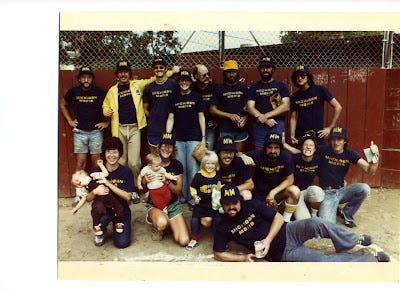

You have to go back to 1978 to understand the story of the Michigan Mafia. A group of us Midwestern migrants started to feel comfortable enough in our adopted Bay Area home to bring a bit of our culture into the local scene. Some journalist colleagues and I issued a challenge to the other media institutions in San Francisco to play us in softball.

Early responders included the San Francisco Chronicle, the San Francisco Examiner, Mother Jones magazine, Media Alliance, and a number of other local media outlets. In the very first game of what eventually became known as the Bay Area Media Softball League (BAMSL) our team, the Michigan Mafia, beat Media Alliance, 3-2.

Over the next 29 years, many teams came and went, partially due to the ever-changing media landscape here. Wired had a team. Some of the TV stations did also. KQED had a team. 

The great Joe Dimaggio threw out the first pitch in a championship game.

Given my own peripatetic career, I often found myself having to play against my employer's team, because I never betrayed the Michigan Mafia. We were always a competitive team, but never a champion. The closest we came was in 1994, when we advanced to the league championship game, only to lose by a wide margin. My only consolation was that I went 3 for 3 in the game.

Also, over the decades, our cumulative won-loss record was just south of .500.

But, much more than our winning percentage, what held the Mafia together was a shared sense of community. Relatively few of the long-term members were media people, ultimately, given the changes in our industry. We ended up as a collection of lawyers, legal investigators, and random others, with just a few aging journalists sprinkled into the mix. Most of us were indeed from Michigan, at least loosely.

Tonight, our venerable coach, Joel Kirshenbaum, announced his retirement, which presumably signals the end of the Michigan Mafia.

"Only the mediocre are always at their best." That was our motto. Some years, however, we came tantalizingly close to being better than mediocre. We played some great games, and had some great parties as well.

Although I feel sad tonight, very sad, at the passing of one of my main social institutions over the years here in San Francisco, I feel like toasting my many colleagues, hundreds of them, who helped make the Mafia if not the best team, certainly the most intriguing team of our era.

As for me, I played in every year during our 29-year run. But last year, in limited at bats, I did not get a single hit. You have to know when it is time to step down, and even if the Mafia had gone forward, I was figuring I should retire. I never did make it to my goal of a career batting average of .600, but I came quite close.

On the other hand, my fielding was suspect, as was my base running, and my (ugh) relief pitching. No, I never was a pretty player, but like my teammates, I always gave it all I had.

Good-bye, Michigan Mafia. R.I.P.

NEWSLINKS:


Tuesday, October 18, 2022

Differentiating

Virtually every tech startup that I met with during my years as a consultant/blogger/media analyst wanted me to help articulate how they were different from anyone else out there.

That was kind of an obvious need, wasn’t it, because in order to get funding from the VC community and adoption by the public, these companies needed to make a case compelling enough to get people to take that first step — which usually was that first click.

After that, it was a matter of a compelling enough user experience to attract repeated usage, hopefully massive repeat usage as in addictive behavior, a willingness to spend money, and communicate to others in a way that attracted still more usage.

But truth to tell, most of them did not have a unique idea that could be fully differentiated from their competitors. Rather, they tended to be poised at the edge of a new consumer or business trend along with several other groups and probably one only was going to succeed in becoming the category-killer.

My work in these cases involved helping to forge their story. And when I think back on it, my contribution in all cases was only as good as the story they actually had to tell.

The groups I worked with fell into two broad categories — for-profit startups and non-profits. Those are seemingly radically different creatures but in fact they have a lot in common.

Resources — both financial and human — are in short supply, at least at the quantity needed to sustain a long-term play. They all had competitors. They all had visionary founders. And most of them were trying to fashion sexy founding myths.

As a journalist, writer and editor, I could improve their use of language, advise them strategically on positioning and help shape their story. But I couldn’t help them succeed on the basis of fiction.

Their stories had to be true. And the product or service they were offering had to deliver on its promise. Due to that irrevocable state of play, my help was only as successful as their truth allowed.

In this case, what is true in business is also true in life.

NEWSLINKS:

Monday, October 17, 2022

As Real As A Memory

During the years that my sidelight career was selling Robert Rauschenberg paintings, I tried to catch up on my limited knowledge of abstract expressionist history.

Inevitably, I was drawn to Rauschenberg's "Erased de Kooning Drawing," an experiment about the limits of art.

At the time the two artists combined on the piece, 1953, I was being instructed to erase my own writings and drawings as a first-grader in school. At the time, we were told that we were to erase our "mistakes" as part of the process of learning how to write and draw correctly.

Rauschenberg, of course, had a very different purpose in mind when he asked Willem de Kooning to produce a drawing that he would erase. He sought to discover whether an artwork could be produced entirely through erasure— the removal of what was once there, sort of like creating a ghost.

It would not be a mistake at all, but an act entirely on purpose. And the result would be a work based only on the memory of what used to be. 

This is, after all, very similar to what happens in life on many occasions. It happens when we lose all of our possessions to fire, theft, loss or a conscious decision to eliminate them from the premises. It happens when we get dementia.

It also is what happens when somebody we love dies.

It is also what happens when autocrats try to erase history, criminals try to cover up crimes, or genocidal maniacs attempt to remove an entire people from the planet.

In the case of the actual de Kooning drawing, Rauschenberg and Jasper Johns carefully matted and framed the work (pictured above), with Johns inscribing the following words below the now-obliterated piece:

"ERASED de KOONING DRAWING"
"ROBERT RAUSCHENBERG"
"1953"

The psychologically loaded history of the creation remains otherwise unknowable.

But as long as we remain aware of what happened, what was once drawn, and what was once seen, it is as real as we need it to be.

Just like our memory.

I first published an earlier version of this essay a year ago.

NEWSLINKS:


Sunday, October 16, 2022

Identity Through Time

 A recent article in the New Yorker asked the provocative question: “Are You the Same Person You Used to Be?” 

Without over-simplifying a complex discussion, I can say that the author alleges that most of us fall into one of two camps — those who remain more or less consistent throughout their lives (continuers) and those who seem to live life in stages, changing and adapting along the way (dividers).

Reading articles like this reminds me of taking those tests that supposedly help experts classify you as one of up to (if I’m remembering correctly) nine different personality types.

I’ll be blunt here: I think that nine-square matrix is nonsense, though I suppose it serves some useful purpose somewhere. But it’s an absurd over-simplification as far as I’m concerned. 

On the other hand, this two-type dichotomy feels more relevant. When I think about other people, some of those I’ve known for decades and decades do seem to have remained relatively unchanged over time, while others have most definitely undergone dramatic changes and evolved into rather different people than they were back in the day.

In my case, there are quite a few people who have known me for 50 years or longer, so I’ve gotten some relevant feedback on the matter, particularly from my professional colleagues and friends.

And quite a bit of it lately.

I’d have to say that the feedback has been decidedly mixed. Some tell me that I’ve changed dramatically; others see continuities that even I am unaware of. In any event, this all feels particularly salient since a group of producers in Hollywood is considering making a television series based on work I did in my 20s at Rolling Stone.

That is when I co-authored the Patty Hearst series. And it definitively changed my life. Reconstructing the choices and actions I made 50 years ago raises some questions I have a very hard time answering today:

Am I essentially the same person now who did that work back then? Would I do it all differently now? Do I have any regrets? Did that work change me somehow? Has my life been predictable or a series of stops and starts and left turns?

Stay tuned. After all, first we have to see whether that series even gets made. But either way, the questions will remain, won’t they, not just for me, but for all of us.

NEWSLINKS:

Saturday, October 15, 2022

Words and Numbers

 In a coffee shop with an old friend on Friday, we found ourselves speculating about the intersection between math and language. It is the peculiar place on the left-right brain spectrum where my mind often settles, for some reason.

When it comes to math, I like the logic and the specificity, and the certainty that there will be an answer, once enough patience kicks in.

When it comes to language, I like the cadence and trajectory, but also the Old Germanic specificity of English. Well, actually, I also like the layers of meaning and adaptability of English, thanks to the Norman invasion and other historical events that altered the course of the Anglo-Saxon dialect with French diversions.

Maybe, when it comes to it, what I really like most about English is using it to achieve ambiguity, which is quite unlike math. Whenever I can convey multiple meanings with my words, that suits me just fine.

There is a very specific, math-like reason for this. As a journalist, I prefer to avoid being placed in a position where I’m expected to tell people what they should think. That is simply not my job.

My preference is to present the facts as we’ve discovered them to be and let my readers draw their own conclusions.

That’s what I aspire to. Let the math of language meeting the language of math. Where certainty meets its polar opposite. Of course I fail as often as I succeed. It’s the law of averages.

NEWSLINKS:

Friday, October 14, 2022

The Coward

It’s simple. Every American should have watched yesterday’s final hearing of the Jan. 6th committee, but if they missed it, thank god for CSPAN. The committee saved the best for last of its nine hearings.

At the end of the hearing, committee members unanimously issued a bipartisan subpoena to Donald Trump to explain his role in the violent riot at Congress on January 6, 2021.

He’ll never comply, of course, because he lacks the courage to take responsibility for the events that occurred that day and because he would have to commit perjury to deny his guilt.

It’s hard to believe we are already 21 months out from the events of that terrible day and there is so little hope of justice in this case.

The man guilty of planning the riot and inciting the rioters sits in his mansion in Florida, hiding behind lawyers and guards, while a few of his hapless followers get convicted and sent to prison.

But that is no surprise. It’s simple. Trump is not only is a criminal, he is a coward.

I would normally leave it at that but there was bigger news yesterday. The Supreme Court told Trump to shove it.

NEWSLINKS:

Thursday, October 13, 2022

"My Father's War" (Afghan Conversation 44)

This is the latest in a series of conversations I have been having with an Afghan friend about life under the rule of the Taliban.

Dear David:

When my parents were young, in the 1980s, Afghanistan was immersed in a ruinous civil war. The Communist party was in power in Kabul. Before that war, the political and social situations had been relatively favorable for ethnic and religious minorities such as Hazara. So when all ethnic groups rebelled against the central government, Hazaras were among the leaders of the rebel groups. Some political analysts and historians believe that their rebellion against the central government was a big mistake. 

My father says that when he was young, far fewer people were attending school. No girls’ schools even existed in our village. Clergymen told the villagers that schools were against Islam and said they should be avoided. 

When my father was in school in Bamian, the rebels burned the school down. My father returned to his hometown. Then he joined the Islamist rebel groups himself and fought for several years against the central government. The Soviet Union sent troops to defend the communist government, which had the effect of unifying the ethnic groups against the foreign army.

During the years that followed. the Mujahaddin emerged, partly funded by the Americans, and they eventually spawned Al Qaeda and the Taliban. We all know the rest of the story – 9/11, the American response, 20 years of war, and the American withdrawal last year.

In many ways Afghanistan has never recovered from the events of my father’s youth. One way or another, we have been at war ever since.

NEWSLINKS: