Thursday, August 25, 2011
Finally, soccer is back, and along with it, a great deal of pleasure for me. My player is no longer the youngest player on the pitch in the San Francisco public school system games, as he was much of the past two years, but an upperclassman, big, tall, strong, fast, and with a certain amount of attitude.
At this point he knows the way the game is played around here, he knows the fields, and he knows the refs.
The ref in today's opening season game is not one he likes. "He's a power freak. If you question his calls, he talks you down," he told me after the game.
I'm pretty sure what he means by that is the ref makes a player feel disrespected when he questions a call.
The situation today that precipitated our conversation afterward was the moment when I saw Aidan get in the ref's face. An opposing player had kicked his teammate, the keeper, in the chest during an attempt to score but was not called for a foul.
Aidan chose to disagree. The problem with this is he already had been called for a yellow card when he had taken out a striker earlier, and with one more, he would be disqualified from playing in next Tuesday's game.
To his coach's and my relief, a second card was not delivered.
After the game the coach walked over to me and said, "I was really proud of the way Aidan defended his keeper."
That's the essence of soccer for a defender -- you don't stand by and let any opponent mess with your teammate, especially your keeper.
After the game, I watched Aidan and his keeper embrace and smile, because at the end of it all, they had beaten the other team, which was short-handed, 10-4.
Not really anything more than a warmup game, under the circumstances. But a good start, with more difficult challenges to come.
You know what's cool? In a society that continues to pretend that race is a divisive issue, I have a son who is the only white kid on a team with two Asians and maybe 25 Latinos. English is the second language on this team. He's an outlier, in other words, someone way outside of the normal comfort zone for most kids like him.
But then again he's an athlete, who loves soccer, and considers himself a student of the game. And, he's a competitor who plays the game hard.
For me, it's all just a joy to watch. Plus his Spanish is getting way better.
-30-
Saturday, August 20, 2011
America: Bad English and Bad Policy
I fear I'm doing a really bad job, now, at blogging.
In order to do this (or any kind of writing) well, it should be a daily habit, as I've always told my students.
But I've allowed myself to grow distracted and not given this space the attention it deserves.
Consider the DMV. For those not in California or some other location that uses the same idiotic abbreviation, this would be the Department of Motor Vehicles.
I've been hanging out there a lot lately, as I try to help my 16-year-old get his "learner's permit."
In case you've not been lately, it's not a lot of fun at the DMV. Even my son, who's normally forgiving and rather sweet about people and their frail points, has begun to rail against bureaucrats.
He also, like me, has a serious problem with taking multiple-choice tests.
***
When I was young, most of the feedback I got from teachers and peers and from the others in our community who shape our early perceptions of who we are was that I was smart.
I had no independent concept of what "smart" meant.
I was just me. Where I lived, "smart" was not a good thing, actually, but the kind of quality that easily got you beat up.
My Dad, probably sensing all of this and more, taught me how to defend myself, should attacks be forthcoming, and I think I learned his lessons well.
***
As my son was told he had failed his first attempt at passing the DMV written test, he shrugged his shoulders, turned, looked at me with that knowing gaze, and we left the building.
Nonsensically, I know, the sound track playing through my head as we left was "Elvis has left the building."
Because, compared to that ridiculous test, those helpless bureaucrats who administer it, and most of all those terrible writers who actually wordsmith such documents, he is a rock star.
The questions he "missed" were the same ones I would miss -- questions so poorly worded, so ambiguous, incomplete and misleading that no true 16-year-old could guess at what the right answer might be.
Allow me to give you an example. I have his test results right here.
Consider Question 26:
Which of these statements is true about child passengers?
1. Children one or older and over 20 pounds should ride in the front seat.
2. Children under age of one should not ride in the front seat in air bag-equipped vehicles.
3. The front seat is generally safest for children six years of age and older.
The correct answer, of course, is (2). But consider the brain development of a 16-year-old, particularly one who has a lot of experience with little nephews in the age range of one to six.
Naturally, the manipulation of answer (2) eluded him, because he was seeking the least-worst answer, and easily chose a six-year-old to be in the front seat over anything mentioning a one-year-old.
His question to me, when he saw he had answered it wrong, tells it all: "Why did they ask about a one-year-old and air bags? Shouldn't a kid be, like 12, before they sit there, Dad?"
He's right, and the question-maker is wrong.
Case closed, but that also raises the issue of whether we should even be expecting kids his age to learn how to drive in our modern society.
Maybe the whole problem is that as a society have not bothered to develop a decent public transportation system. Like other parts of adulthood, voting and drinking, maybe the legal driving age should be raised too.
If I'm not mistaken, it was set at 16 at a time when we were largely a rural people. Even then, in my youth, it extracted a terrible toll to have teens behind the wheel.
Now? If the only way we can keep them from obtaining their permits is via bad writing, trick questions, and the like, maybe we need to find a better route to the destination we all,collectively, ought to be seeking.
Thursday, August 11, 2011
Time Being Relative
There are reasons to appreciate the perspective of a twelve-year-old over that of someone four or five times older, and vice-versa, but in the spirit of the former, today I enjoyed driving my youngest daughter back home from a vacation with friends up in Sonoma County.
She sees everything with fresh eyes. She said she'd never seen the fog rolling over the Marin Headlands like a waterfall today. Or that house way up above Sausalito (probably because she's usually in the backseat.)
But my favorite was about the unripe pear we plucked from a tree up-country before we began our long drive south.
It was firm, too firm to eat, and I told her with a bit of time it would become nicely edible.
Apparently, she interpreted that to mean time in the short-term sense.
As we reached San Francisco, she grabbed the pear and pressed it. "Feels still the same, no softer yet."
No indeed. Not quite yet.
-30-
Monday, August 08, 2011
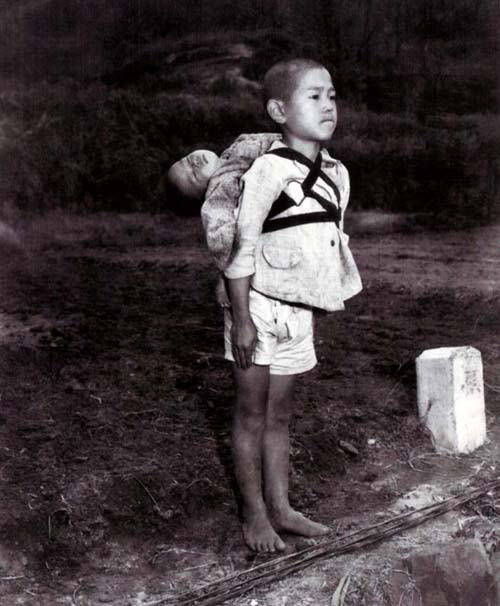
Joe O'Donnell and His Photos After the Atom Bombs Were Dropped on Japan
This post is in honor of a wonderful American artist who has never, in my view, been properly honored in this country, as well as in memory of those many innocents who perished, and whose suffering he captured so movingly.
The reason his work has been largely ignored is due to the subject of his art -- a brilliant and deeply disturbing collection of photographs in the immediate aftermath of the atomic bombs dropped by the U.S. military on Hiroshima and Nagasaki at the end of World War II.

The reason his work has been largely ignored is due to the subject of his art -- a brilliant and deeply disturbing collection of photographs in the immediate aftermath of the atomic bombs dropped by the U.S. military on Hiroshima and Nagasaki at the end of World War II.

Young boy carrying his dead baby brother to the American forces for cremation.
Joe O'Donnell was a photographer attached to the military units poised in invade Japan in August 1945, when, unbeknownst to him or any of his fellow troops, the U.S. deployed its super-secret super-weapon -- not at military targets but over two cities filled with civilians who had nothing at all to do with their government's war.
Many innocent people died, of course, but I do not write these words to condemn the decision by the U.S. government. Despite many years of reading and researching and thinking about these terrible events, I'm not sure how to evaluate these bombings in moral terms.
There are many who argue that they helped end a terrible war that had it not been ended in this manner, would have caused many, many more to die, including an untold number of the American troops waiting offshore alongside Joe O'Donnell.
Plus many Japanese troops and civilians as well.
Others argue that the U.S. could have demonstrated that it possessed such a superior weapon that continued struggle was fruitless by dropping the first A-bomb on some part of Japan where so many innocents need not have lost their lives.
This camp also raises the pertinent question of why, after devastating Hiroshima, the U.S. then proceeded a week later to do the same thing to Nagasaki. Why the second bomb?
According to an NHK documentary I was marginally involved with a few years back, it turns out that the Japanese government, under siege much as Hitler's was in his final days, never was able to confirm what had happened at Hiroshima before what was delivered to Nagasaki.
Those times were not like our times. Communications systems were primitive; information moved at the speed of a slow car, not the speed of light.
Meanwhile, the U.S. had issued a demand that Japan surrender or the second bomb would be deployed., and when the high military command in Tokyo did not surrender by the deadline, the tragedy at Nagasaki occurred.
In any event there is much more I want to express about these subjects but tonight my main goal is to direct anyone who reads these words to my friend Tyge O'Donnell's site. Tyge the son of Photographer-Artist Joe O'Donnell, nd has waged a tireless battle, along with his father's second wife, a Japanese woman, to help Joe's remarkable work to receive the attention it deserves.
I could embed the YouTube video Tyge has created based on our conversation two years ago here, but I would rather that all of the traffic go to Tyge's site, the Neon Lounge. He is a fine writer, who covers a wide range of topics well, but when he writes about his Dad, and his Dad's work, he is at his absolute best.
Please go see for yourself.
-30-
Friday, August 05, 2011
Dog Days Wet
Our new buddy Brando fell into the fish pool this afternoon. As far as I recall, he is the first person, dog or cat to do so. The raccoons are afraid to go in there. Brando apparently mistook the green plants coating the top of the pond as evidence that it was a solid surface, not a watery hole.
-30-
Is That You I See?
Note: I first published this a year ago today. It remains as true now as it was then, for me.

We've got lots of cliches about the passing of time in English. Some relate to how we forget.
We can forget how someone looks. We can forget how it felt to be with them. We quite easily, it seems, forget the good along with the bad.
It all goes away, somewhere far from here.
After a while, trying to recall, the only image we can summon is fuzzy. No matter how hard we try, nothing comes back into focus.
Maybe it's just as well, maybe the person and experiences we were trying to recall were never anything but illusions anyway.
So what's left to he who would try to see is -- nothing. Once you've been written out of the story, the story itself ceases to exist.
Stories are like plants, they can easily wither and die once no one is taking care of them any longer.
In time, the story may return in some sort of romanticized version or as a cautionary tale about the dangers of giving away too much to others. Or maybe it will just stay gone, which might be just as well.
What's left? That may be an empty field you see, a place to build a new beginning. Or it may be a truck barreling down on you to flatten you once and for all.
You can't tell. Most likely it is nothing at all, just an out of focus void. There is no field, there is no truck, there is no other, there only is you and you are alone.
So, you see, you better get used to it. That's what the world is trying to tell you now. You're on your own.
-30-
We've got lots of cliches about the passing of time in English. Some relate to how we forget.
We can forget how someone looks. We can forget how it felt to be with them. We quite easily, it seems, forget the good along with the bad.
It all goes away, somewhere far from here.
After a while, trying to recall, the only image we can summon is fuzzy. No matter how hard we try, nothing comes back into focus.
Maybe it's just as well, maybe the person and experiences we were trying to recall were never anything but illusions anyway.
So what's left to he who would try to see is -- nothing. Once you've been written out of the story, the story itself ceases to exist.
Stories are like plants, they can easily wither and die once no one is taking care of them any longer.
In time, the story may return in some sort of romanticized version or as a cautionary tale about the dangers of giving away too much to others. Or maybe it will just stay gone, which might be just as well.
What's left? That may be an empty field you see, a place to build a new beginning. Or it may be a truck barreling down on you to flatten you once and for all.
You can't tell. Most likely it is nothing at all, just an out of focus void. There is no field, there is no truck, there is no other, there only is you and you are alone.
So, you see, you better get used to it. That's what the world is trying to tell you now. You're on your own.
-30-
Wednesday, August 03, 2011
Subscribe to:
Posts (Atom)